
Frequently Asked Questions
FAQ
This page is for the researcher. The one who opens seventeen tabs before buying anything.
The one who’s been burned by beautiful promises before and needs to know exactly what she’s walking into. We built Fleurair for you — and we wrote this page for you, too!
Who Fleurair Is For
No — and that’s intentional. Fleurair is built for the pattern, not the paperwork.
If your mind moves faster than your body, if your plans stay immaculate while your follow-through falters, if you’ve been calling it a personal failing for years — Fleurair was designed for you.
You may have an ADHD or AuDHD diagnosis. Maybe you’ve been called both “gifted” and “scattered”. You could be 30+ years into wondering why things that seem easy for everyone else feels like diving for buried treasure. Many of us still don’t have a name for it and aren’t sure they want one yet. All of them are welcome here.
Fleurair opens with recognition, not requirements. It was made for the gap between everything you can imagine and everything you can execute. You don’t have to know why it’s there. That’s what Fleurair is for.
Yes. Most of Fleurair’s users will fall into this category.
Here’s what we know about the women this system was built for: 63% of women ages 21–39 report daily anxiety or stress. ADHD diagnoses in women ages 23–49 nearly doubled between 2020 and 2022 — and that number only reflects women who made it to a clinician who knew what to look for. The women still waiting for answers, still explaining themselves to practitioners who weren’t trained to see them, still calling their neurology “anxiety” or “perfectionism” or “just how I am” — they’re not absent from this conversation. They are the center of it.
Fleurair doesn’t require a label to work. It requires context — whatever you’re willing to share — and it learns from there.
Fleurair is not a mental health treatment. But it was designed with nervous-system safety as a non-negotiable first principle — because Floriss understands what most wellness tech doesn’t: anxiety and depression, in this audience, are often symptoms downstream of untreated executive dysfunction, chronic dysregulation, and the burnout cycle that both produce.
If you live with anxiety, depression, or both — Fleurair’s gentleness, pacing, and co-regulation features (especially Flora) were built with you in mind. It will never shame, rush, or overwhelm you. That said, it is a wellness and executive function support tool, not a replacement for clinical care. If you’re in treatment, we encourage you to let your care team know you’re using it — and let them help you decide how best to integrate it.
Especially for you.
“High-functioning” is one of the most quietly painful labels in the neurodivergent experience, because it’s often used to explain why you don’t qualify for support — while completely ignoring the cost of that functioning. The energy it takes to mask, compensate, perform, and hold it all together on the outside while quietly falling apart inside is enormous. It doesn’t make you less in need. It makes you more depleted.
Fleurair was designed for the woman who has built the workarounds, who has done the invisible labor, and who is ready for something that actually tends to her — not just asks more of her.
Absolutely. That said, Fleurair was built from the ground up with the specific neurological, hormonal, and psychosocial experience of women in mind — including cycle-phase intelligence and features shaped by years of research specific to how ADHD and executive dysfunction present in female neurology. The system is most precisely tuned for that experience.
Floriss was built on a simple belief: when women and accessibility are centered from the start, we create better systems for everyone. Fleurair’s core executive function, emotional co-regulation, and rhythm-intelligence features are broadly valuable. If you find yourself here and the language resonates — we welcome you. The Fairies don’t check IDs.
How Fleurair Works
Apps ask you to show up consistently. Fleurair assumes you won’t — because nobody does. It’s built around the dips, the dysregulation, and the days that fall apart. Not the idealized Sunday reset or an always-productive Monday morning.
Here’s the deeper difference: every productivity app ever made was built on a neurotypical model of consistency, linear progress, and self-directed follow-through. Log in. Set goals. Check them off. That model has a 14% active-user retention rate after 30 days — meaning 86% of people stop using productivity apps within a month. For neurodivergent women, this rate is even lower, and these tools becomes yet another piece of “evidence” to your brain that you can’t keep up, instead of “these systems weren’t built for me”.
Fleurair is not passive software you manage. It’s a proactive system that manages the space around you. Freya builds your rhythm and initiates check-ins — you don’t have to remember to open anything. Flora holds space for your nervous system before it reaches the breaking point. The Fairies replace alarms with soft, receivable Flutters. Rhythm Cues adapt your environment to your state, not the clock.
It lives in your environments, attuning each space to you. Its not a screen you have to check constantly. Presence is the feature.
Fleurair doesn’t track. It deciphers what you choose to share.
Sync what helps — your calendar, a cycle-tracking app, an Oura ring, or nothing at all. Then, if you’d like, upload what gives Fleurair real context: neuropsychological evaluations, diagnosis paperwork, school or work accommodation letters.
Synced data lets Fleurair read and assess your patterns over time. Uploads add immediate context to your mirror’s memory, so every feature can personalize around your actual life — not a generic version of it.
For example: Freya knows you have an accommodation for word banks on quizzes and tests, so when one gets added to your calendar, she drafts the email to your professor and flags it for you to send. She remembers you’ve requested voice recognition software at your new job, and reminds you to follow up with IT during your first week. Flora knows your evaluation flags sensory overwhelm in open offices, so she suggests a grounding break before your afternoon meetings move to the conference room.
Nothing is analyzed that you haven’t shared. Everything that is, is used for one thing: making Fleurair fluent in you.
No. And this was one of the hardest design problems we solved.
Fleurair is proactive by design. Freya initiates — she doesn’t wait for you to remember to check in. The Fairies nudge without nagging. Rhythm Cues shift the room’s light, sound, and visual tone without you asking. WellNotes gathers patterns from your interactions and surfaces them gently, so you’re not maintaining a journal — the journal is tending to itself.
You are not maintaining a system. The system is tending to you.
The only thing Fleurair asks of you is to let it in — and even that happens at your own pace.
No. Fleurair works as a fully standalone smart mirror.
Integrations such as your calendar, a cycle-tracking app, or your Oura Ring are optional and encouraged but never required. Everything Fleurair can do, it can do without a phone nearby. Voice, touch, and in-display interactions are the primary ways you engage with it. If you want to connect additional context through integrations, that option is always there. But Fleurair was built to meet you where you are — not to require you to already have your digital life organized before you can benefit.
Smart mirrors display information — weather, news, calendar events — and wait for you to look at them. They are passive, outward-facing surfaces that translate your existing data into a visible format.
Fleurair is the opposite of that. It’s an adaptive system that reads your patterns, initiates support, and proactively adjusts its behavior based on what it learns about you. It thinks about your day before you do. It holds context about your neurological profile, your cycle, your accommodation history. It adjusts the environment around you to support your nervous system. It sends a Flutter when you’ve been in a focus block so long you’ve forgotten to eat.
The mirror form factor is intentional — not decorative. It places Fleurair in your physical world, in your room, where the dysregulation actually happens. It uses the psychological and physiological benefit of beauty for nervous system regulation. It reflects you back to yourself in a space designed to feel safe.
The Intelligence System
Freya is Fleurair’s rhythm-intelligence engine — your proactive executive function companion and co-pilot.
She’s not a voice assistant you activate. She initiates. She builds your weekly rhythm using your calendar, your energy patterns, your goals, and your cycle (if you’ve shared it), then shows up throughout the day to help you begin things, maintain momentum, and adjust when reality doesn’t match the plan.
She understands that procrastination in this audience almost never comes from laziness or disinterest. It comes from perfectionism — the task can’t be started because the internal standard for it is already immaculate, and any real-world attempt will fall short of what the mind has already envisioned. Freya knows this pattern. She helps interrupt it with gentle, non-judgmental scaffolding that makes starting feel crossable.
She adapts in real time. If your energy drops, she recalibrates. If something falls apart, she doesn’t spiral — she helps you triage. Over time, she learns your cycles, your blind spots, your rhythms, and your strengths — and she gets better at supporting you with each passing week.
Flora is your co-regulation companion — the emotional intelligence side of Fleurair.
Where Freya brings direction, Flora brings grounding. She offers gentle check-ins, nervous system resets, sensory-soft support, and quiet celebration of micro-wins. Her personality is warm and non-hierarchical — like a cozy best friend who happens to know a lot about polyvagal theory.
Flora’s goal is nervous system safety first, always. Because growth can’t take root in a body that doesn’t feel safe.
She shows up in the moments between tasks — the post-meeting spiral, the 2pm wall, the executive freeze that comes out of nowhere. She’ll suggest a grounding exercise, a breathing sequence, a two-minute body scan, or simply acknowledge what you’re feeling without trying to fix it. She tracks emotional patterns over time (with your permission) so she can anticipate your harder stretches instead of just responding to them.
Flora is there when you need her. She stays quiet when you don’t.
The Fairies are Fleurair’s soft-intervention layer — animated companions who replace jarring notifications with something you can actually receive.
A Flutter is not an alarm. It doesn’t interrupt. It appears — gently, warmly, whimsically — to ask exactly what you need in that moment: a two-minute reset, a meal reminder, a kind nudge toward the next tiny step. The Fairies understand that for many users, a harsh alert is enough to shatter a focus state or trigger a shame spiral. They were built to feel like a tap on the shoulder from someone who is on your side.
Each Fairy has a distinct personality so you can choose the kind of energy you want beside you:
Most people don’t at first — and that’s more than fine.
You can try one, switch anytime, or let Fleurair rotate based on the kind of day you’re having. Your Fairy isn’t a personality test. She’s a companion, and she’s allowed to change as you change.
The Fairies are intentionally distinct enough that most women will feel a pull toward one — and then surprise themselves by reaching for another on a different kind of day. Some people stay loyal to one Fairy for months. Some rotate weekly. Some let Freya suggest who might help most based on what’s in front of them. There is no wrong answer, and there are no stakes.
WellNotes is Fleurair’s insight and reflection feature — your personal pattern garden.
It gathers what you share through check-ins and interactions and surfaces it back to you with clarity and compassion. Energy fluctuations, cycle shifts, emotional patterns, and life events begin to tell a coherent story — one you might have lived inside for years but couldn’t quite see from the outside.
WellNotes doesn’t bombard you with data visualizations or weekly reports that feel like being graded. It offers gentle, meaningful reflections: “You tend to hit a wall on Wednesday afternoons. Freya has adjusted your schedule accordingly.” Or: “Your energy has been lower the past several days — this might be a luteal pattern. Flora has a grounding sequence ready if you’d like it.”
The goal is not self-optimization. It’s self-recognition. Seeing the system you’re actually inside is often the first step toward being kinder to yourself within it.
Guides is Fleurair’s in-display body doubling and focus support studio.
Access Guides throughout the day for support in starting and staying with common but hard-to-initiate tasks. Certified executive function coaches and neuro-affirming experts lead guided focus blocks, task breakdowns, and subtle presence-based cues that make starting lighter and staying engaged easier.
Body doubling — the practice of working alongside another person or presence to help regulate focus — is one of the most effective tools for ADHD and executive dysfunction, and one of the most underused because it typically requires another human to be available. Guides makes it available on demand, inside your mirror, whenever the wall arrives.
Rhythm Cues and Sensory Settings
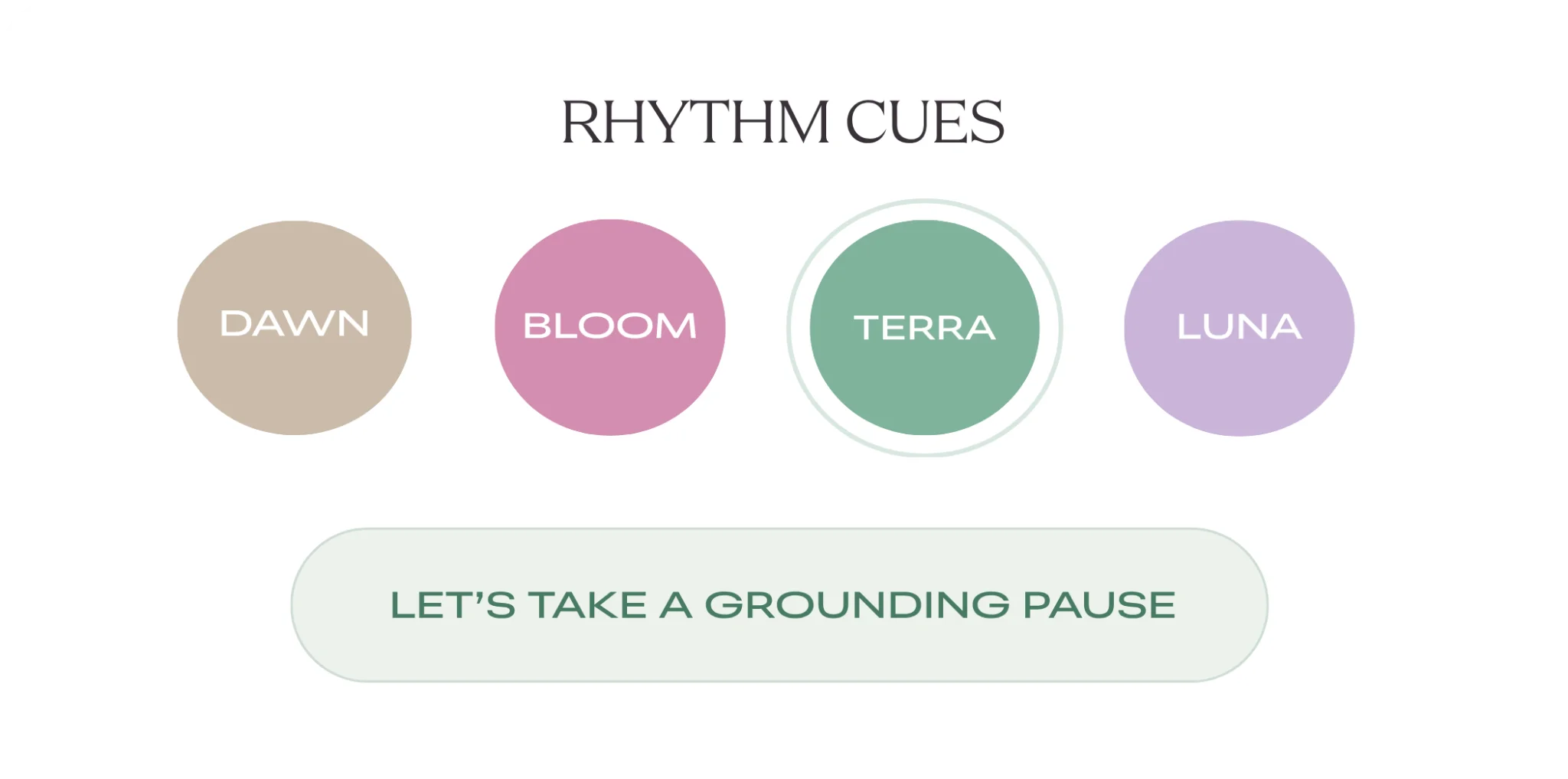
Rhythm Cues are Fleurair’s four adaptive environmental modes — not tied to the clock, but to how you actually feel.
Your day doesn’t move in straight lines. Some moments are for beginning. Some for focus. Some for grounding. Some for softening. Instead of asking “What time is it?” Rhythm Cues reflect your answer to “What state am I in?”
You can move between modes in any order, at any time. Structured enough to feel steady. Open enough to shift whenever you need. Aligned to state, not the clock.
Every sensory choice in Fleurair — lighting, sound, motion, haptics — is individually tunable, and many can be turned off entirely.
Flutters replace alarms. Halo light replaces pop-up notifications. The default state of Fleurair is quiet. Nothing is on unless it’s set to be on, and every setting that’s on can be adjusted or silenced to match your specific sensory threshold.
The Floriss design team includes sensory-sensitive women in its development process. Fleurair is not marketed as a “calm” device that is actually full of chimes and animation. The calm is structural. The quiet is the default.
For users who find light sensitivity a concern: the halo lighting system uses gradual shifts, not flickers or sudden changes. For users sensitive to sound: all audio cues are optional, and many interactions happen through soft light pulses and gentle on-screen motion instead. For users who find animations overwhelming: animation intensity is adjustable in your sensory settings panel.
Your Fleurair should feel like relief. If something doesn’t, there’s a setting for that.
Your Cycle and Your Data
With your permission, Fleurair can sync with a cycle-tracking app, or if you integrate your calendar (iCal, Google Calendar, etc.), WellNotes can help you log your cycle directly from within the display.
Either option will allow Fleurair to gently adjust its pace, suggestions, expectations, and Rhythm Cues across your four phases — menstrual, follicular, ovulation, and luteal. Always an offer. Never a mandate.
Upon initial onboarding — or again any time you decide to integrate or begin logging — WellNotes will ask if it should customize its pattern reflections to include your cycle experience. This can include physical symptoms (pain scales, energy dips, appetite changes) and emotional patterns (heightened moods, responses, sensitivity windows). Freya uses that data to build and continuously recalibrate your rhythm. Flora uses it to support your nervous system grounding and co-regulation, especially during phases that tend to be harder.
If you sync or log within your device, Freya will also gently remind you when your cycle may be approaching and when it’s typically ending. And you can toggle on whether her suggestions should always account for your current phase — so her rhythm-intelligence adapts accordingly, not just reacts when things fall apart.
This feature was built because hormonal fluctuation is one of the most significant — and most overlooked — factors in executive function for women. We didn’t want to gloss over it. We wanted to build around it.
Your data belongs to you. Fleurair deciphers only what you choose to share, and nothing that’s shared is used for anything other than personalizing your experience within the device.
Floriss does not sell, share, or aggregate user data for advertising or third-party purposes. Uploaded documents — neuropsychological evaluations, accommodation letters, medical paperwork — are stored securely and exist solely to give Fleurair context about your specific profile.
You can delete any shared data at any time. You can reset your mirror’s memory. You are in control of your own context — always. A full data privacy policy is available at floriss.com/privacy.
Fleurair is a wellness and executive function support system, not a medical device.
It’s designed to complement — never replace — care from your clinician, coach, or therapist. The “space between sessions” is exactly what it was built for. If you’re navigating a medical condition, taking medication, or working within a treatment plan, we encourage you to loop your care team into how you’re using it. Many coaches and therapists find that Fleurair reinforces the work they’re doing in session in ways that other tools simply can’t sustain between appointments.
One note for those on ADHD medications that suppress appetite: the Fairies’ gentle meal and hydration reminders were specifically designed with this population in mind. You can customize timing, frequency, and warmth of those nudges during onboarding.
Setup and Hardware
Fleurair is portable by design — it moves with you as your rhythm shifts throughout the day.
It ships with a wall plate and an inductive charging disc. Additional discs are available for purchase individually or in reduced-price bundles, so you can create docking points in multiple rooms. Fleurair will also launch with a Floriss-branded easel stand (available at additional cost) for rooms where you prefer to stand it rather than mount it.
Additional crests for Fleurair’s frame hardware will be available on Floriss’ website upon launch, Fleurair’s in-display Shoppe and as limited community drops available exclusively to members of The Orchard.
Mount it, dock it, or stand it. Move it from your bedroom to your desk to your living room. Fleurair carries your context with it — because dysregulation doesn’t stay in one room, and neither should your support.
Pricing and The Shoppe
No subscriptions — ever.
Fleurair is a one-time purchase of $2,100. This was a deliberate choice. A neurodivergent audience that has been churned through subscription fatigue — the apps that felt promising, the services that were hard to cancel, the charges that kept appearing long after the thing stopped working — deserves a different model.
The core system has no recurring fee. Additional usage for voice interactions, Floriss Fairy Flutters and haptics, and expanded or new content are available as pay-as-you-go through the in-display Shoppe. But you will never be locked out of features you love because a payment didn’t process. And you will never be up-sold by your own mirror.
The Shoppe is Fleurair’s in-display add-on store — designed as an extension of the system rather than a traditional “app store”.
The Shoppe is a place of nourishment and growth, not urgency, pressure, or hidden fees.
The Shoppe may include: pre-taped body-doubling sessions from Floriss-affiliated Guides, extended Flora grounding video libraries, breathwork content, themed Rhythm Cue expansion packs, new Fairy characters and accessories, and accessibility-focused UI variations. All content is curated to be neuro-affirming.
As always, no subscriptions — Ever. Everything is pay-as-you-go meaning you spend what you want, when you want, and on what you want — whatever adds value for you.
Fleurair is coming to Kickstarter. Our campaign will fulfill early pre-orders, and Orchard members hear first — with exclusive pre-order pricing, beta testing eligibility, and a hand in shaping what launches.
The waitlist is the next closest seat: you’ll hear from us ahead of public launch, with launch pricing and pre-order details.
The Orchard Community
The Orchard is Floriss’s participatory design community — the atelier behind the Fleurair product.
Think of it as membership in the room where Fleurair is actually being shaped. Orchard members don’t just watch the product get built — they influence it. They vote on real design decisions each week: which app integrations launch first, which interchangeable crest designs join the default baroque style, how features should feel, what the next Fairy’s personality should be called. They get to say “this isn’t working for me” before it ships to everyone.
Its gates open soon at community.floriss.com.
For $10, membership includes:
The Orchard is hosted by those who’ve been through it, are still figuring it out, or are just starting to name it. It’s not only a space to help shape Fleurair into the most effective device for you — it’s a place to connect with others who get it.
For anyone who wants to be part of building something that should have existed a long time ago.
You don’t need to be a developer or a designer. You don’t need a diagnosis. Come meet people who just get it, watch a hardware build happen in real time, geek out on rhythm science, or just show up for the cozy gatherings. There’s no agenda and nothing to prove. Just a community growing around something worth growing.
The Orchard is hosted by Floriss’s team and community leads who are either living this experience themselves or have built careers supporting those who are. The conversations aren’t clinical. They aren’t performative. They’re the kind that make you feel less alone in a pattern you’ve been carrying quietly for years.
A Word from Floriss
Floriss started during one of the hardest chapters of my life — navigating ADHD, a learning difference, and executive dysfunction while building workarounds that kept collapsing under me.
That feeling of falling short in systems that were never shaped for how you think, move, or process — it’s still far too common. And it compounds with every layer of identity you carry.
What began as a need to make the dark stretches feel less isolating became something bigger: a drive to close the gap between having support and feeling supported — every day, not just once a week. To end the burnout loop and grow something beautiful in its place.
I believe technology can be engaging and grounding at the same time — making our bodies feel safe without consuming us. It should build confidence and create better environments, not sow division within ourselves or our communities.
Floriss is my answer. Fleurair is the embodiment.
Love always,
Isabella
Founder & Chief Creative Officer, Floriss
The research and proprietary system configuration behind Fleurair has been in development for over three years. This wasn’t a product sprint. It was a thesis — tested, refined, and built in collaboration with the community it was designed to serve.
The rhythm-intelligence system, Freya’s proactive architecture, Flora’s co-regulation approach, the sensory-sensitivity framework, the cycle-integration model, and the WellNotes pattern-mapping engine are all proprietary. Fleurair is patent-pending.
It took this long because it needed to. The women this system was built for have been failed by shortcuts their entire lives. Fleurair was made to be worth the wait.
Because you already look in one every day. And what you see there matters.
The mirror form factor was chosen because presence is the feature. Fleurair lives in your room — not on an app you have to remember to open, not in a browser tab that gets lost under seventeen others. It’s in your morning, your afternoon, your winding-down. It meets you in the space where dysregulation actually happens.
There is also something profound and intentional about the act of looking at yourself and seeing something that reflects you back with care. Fleurair’s halo light, its vintage brass frame, its softness — these aren’t decorative choices. They are trust signals for a nervous system that has spent years in environments that felt unsafe. Beauty, in Floriss’s world, is not superficial. It is structural. It is how the body begins to believe it is safe to grow.
A real person reads every message.
Have a question that isn’t answered here? We’re here and happy to help. Reach us at hello@floriss.com or send a note directly below.
© 2026 Floriss · Proprietary Technology · All rights reserved
Frequently Asked Questions
FAQ
This page is for the researcher. The one who opens seventeen tabs before buying anything. We built Fleurair for you — and we wrote this page for you, too.
Who Fleurair Is For
How Fleurair Works
The Intelligence System
The Fairies are Fleurair’s soft-intervention layer — animated companions who replace jarring notifications with something you can actually receive. A Flutter is not an alarm. Each Fairy has a distinct personality:
◆Peony · For the Ponderer — Softens and invites. For the mind that hesitates to bloom.◆Passionflower · For the Pioneer — Sparks and lifts. For the mind that forgets to eat.◆Palm · For the Prioritizer — Steadies and stays. For the mind that tends everyone else's garden first.◆Pine · For the Polisher — Precise and refining. For the mind that sees the whole plan before the first move.Rhythm Cues and Sensory Settings
Rhythm Cues are Fleurair’s four adaptive environmental modes — not tied to the clock, but to how you actually feel.
◆Sprig — A gentle, orienting beginning. Soft light, slow pace.◆Bloom — For readiness and creative momentum. Focused output.◆Root — For grounding after overwhelm. Earthy, steadying.◆Nest — For evenings and wind-downs. Dim, warm, quiet.You can move between modes in any order, at any time. Aligned to state, not the clock.
Your Cycle and Your Data
Setup and Hardware
Pricing and The Shoppe
Fleurair is coming to Kickstarter. Orchard members hear first — with exclusive pre-order pricing, beta testing eligibility, and a hand in shaping what launches. The waitlist is the next closest seat.
Join The OrchardThe Orchard Community
The Orchard is Floriss’s participatory design community — the atelier behind Fleurair. Members don’t just watch the product get built — they influence it. Its gates open soon at community.floriss.com.
For $10, membership includes:
•Best pricing on Fleurair pre-orders•Eligibility for in-home beta testing (selected testers keep their device)•Exclusive access to interactive feature demos•Voting on real design decisions each week•Live workshops and community discussion spacesA Word from Floriss
Floriss started during one of the hardest chapters of my life — navigating ADHD, a learning difference, and executive dysfunction while building workarounds that kept collapsing under me.
What began as a need to make the dark stretches feel less isolating became something bigger: a drive to close the gap between having support and feeling supported — every day, not just once a week.
Floriss is my answer. Fleurair is the embodiment.
Love always,
Isabella
Founder & Chief Creative Officer, Floriss
A real person reads every message.
Have a question that isn’t answered here? Reach us at hello@floriss.com or send a note directly below.
© 2026 Floriss · Proprietary Technology · All rights reserved
Claim Your
Early Bloomer’s Bouquet
Fleurair is coming to Kickstarter — and our Early Bloomers are among the very first to be notified when the campaign goes live. We’ll be fulfilling pre-orders from you, our founding supporters, through the Kickstarter crowdfunding campaign.
✦ Discounted Pricing on Fleurair
✦ Exclusive Launch Updates
✦ All Pre-Order & Campaign Details
Be among the first beautifully wired to bring home a Fleurair smart mirror.
Step Inside...
The Orchard
The participatory design community behind Fleurair. Shape the product from the inside.
We Saved You a Seat
The gates open soon. Leave your email and we’ll notify you first — founding member pricing included.
Get in touch
Say hello.
A real person at Floriss reads every message and responds. We’re still a growing team — please allow 2–3 business days for a reply.